Digging Thistles
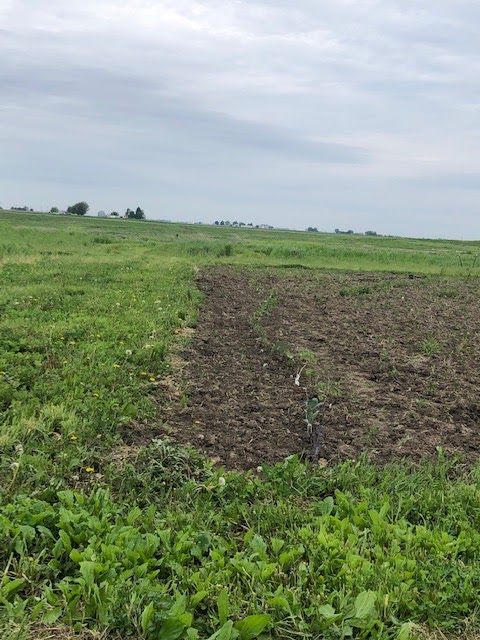
I was fortunate to be given space on an organic farm to plant a row of vegetables. The farm is six miles from my driveway. It has buffer zones separating it from the flat Illinois corn and bean ground around it. One of the big crops on the organic farm this year is sunflowers. That stand of flowers is going to be beautiful.
The plot where my row is planted is part of a large garden that I would call a truck patch. Big garden with rows of all kinds of vegetables. I would show you a picture, but my row is embarrassingly crooked. Next year I’ll use a string.
I have forty plants. Four kale (two Red Russian, two long leaf), twelve tomatoes (plums and slicers), and twenty-four peppers (serrano, habanero, cayenne, poblano, Thai hots, various others). They are in full sun. My hosts supply saved rainwater for watering from tanks connected to the gutters of their big metal shed. A long hose stretches to all parts of the garden. It is a great system. We’ve had lots of May rain, so the tanks are fairly full.
As an organic farm, there are of course no herbicides, pesticides, or chemicals of any kind. The ground is enriched by pelletized chicken manure from an organic chicken operation. I like the concept, but when you are up close to an organic plot you quickly see the difference between the neighbor’s corn and bean fields. Weeds.
Modern herbicides do a frighteningly thorough job of eradicating weeds. Weeds were a fact of life on the farm I grew up on. There were all kinds of weeds we knew by name and fought annually; butter print, ragweed, giant ragweed, lambs quarter, foxtail, pig weeds, thorny pig weeds, jimson weed, goose grass, bull nettles, horse weeds. The list goes on and on.
At some point in the sixties my Dad bought a sprayer, actually just a cart for two fifty-gallon drums with booms and small sprayer heads. He was never comfortable mixing and handling the cans of expensive liquid weed killers. He mowed weeds before they went to seed, and cut them from the beans with weed hooks, but what he liked best was digging them up by the roots. Especially the thistles.
Canada thistles could grow to be the size of small Christmas trees. At the very top where a star would go a purple seed pod formed. If and when it opened the seed would scatter in the wind. I always thought of that line from the Christmas poem “and away they all flew, like the down on a thistle.”
Canada thistles were the bane of my Dad’s existence. Well, that may be a little dramatic, but he hated them. I don’t think he ever blamed the Canadians, but he was always on the lookout for fields where farmers let them go to seed. He believed there should be a special place in hell for those farmers, and he was determined not to be one of them.
And so, on our farm we dug thistles. It was a job always waiting when it seemed there was nothing else to do. Dad taught me how to dig thistles in great detail, telling me about the plant.. He studied things like that. He was most intent on getting thistles out of the pastures. They could be easily seen there. And Dad would never use chemicals where the cows ate grass. It had to be done the old-fashioned way.
Some part of weed control was related to what the neighbors thought. Yes, weeds rob crops of nutrients from the soil and its true they sometimes shade crops from the sun, but they are also a blemish on a farmer’s reputation. Dad wasn’t having it. Especially when it came to those damned Canada thistles.
We strode out to the pasture, each with a spade, and approached an invading thistle. Dad began explaining his personal technique for combatting thistles.
“You gotta think of thistles like icebergs. The most dangerous part of them is below the surface. That’s why we dig them instead of cut them. Cutting thistles only sets them back for a while. Digging them gives you a chance to kill them off for good. It’s the roots. All about the roots.”
He jammed his spade up close to the base of the thistle and drove it deep in the ground with his boot.
“Good to dig thistles after a rain. The ground is softer. They come up easier.”
He pried down on the spade handle, using it like a lever to lift the thistle up.
“Watch that dirt around this thistle. If the dirt begins to lift and the thistle stays put, like this, you’re not deep enough. You want to get under it.”
He pulled the spade out and reset it on the other side of the thistle, this time jamming the blade in deeper. He pried it up again.
“OK, see how I’ve got the whole thing coming up? That’s what you’re looking for. On a big thistle you many have to use your spade all the way around it to get it to lift. But that’s what we want. The goal is getting the root out without snapping it off.”
He pried some more and then lifted the thistle up and out with a big dirt ball around the root.
“Look at this.”
He hit the dirt ball with his spade revealing a long white tap root with smaller roots and tiny white root hairs branching off.
He knocked the dirt off the root completely and scraped it back into the hole where the thistle once stood.
“Leave it out in the sun to dry out and die. If you dig it out and leave it lie there with the dirt on the root it will re-root itself. Especially if it rains. I’ve seen it happen. It sends down roots, curves its head up toward the sun, keeps on growing like nothing happened. There’s a reason there are so many of them. They’re damn tough.”
“But if we dig ‘em out good we get rid of them, right?”
“Well, we knock them back considerably.”
He didn’t want to tell me he’d been digging thistles his whole life. Canada thistles are a weed you can control to some degree. But without chemicals you can’t defeat them. It is impossible for every root hair to come up out of the ground when a thistle is dug. And then there’s the problem of those downy seeds.
“So, we’re going to have to do this again next year?”
“Yeah, most likely.”
That realization dampened my enthusiasm for thistle digging considerably. It was hot out there. Digging, stooping, slapping the dirt off those roots was hard work. And monotonous. I looked across the pasture at the job before us. There were potentially days and days of thistle digging ahead. To make things worse, that first day turned out to be a teaching day for Dad, a learning day for me, and the last day Dad helped me dig thistles. From there on out it was just me.
That’s what I’ve been thinking about since the day I put my plants in the ground on the organic farm. There’s a lot of thistles out there. After that first day I put a spade in the trunk of the Buick, along with a hoe. There used to be golf clubs there.
I went after the big thistles first. They were on the edge of the plot where the ground had not been tilled. They had long roots, probably from being mowed rather than dug. It was hard to stop. I wasn’t sure how long it would be before they went to seed, but I wanted to get ahead of them.
I’ve been going out every morning. I say I’m going out to check on my plants, but to be honest I go out for my sanity in equal measure. Most days it is the only place I go. I haven’t put gas in the Buick for three weeks. I water, prop up plants that are leaning, pick blossoms off the tomatoes and peppers. It’s too early to make fruit, I want big healthy plants first.
When I am satisfied my plants are in good shape, I turn my attention to the thistles. As my plants grow, benefitting from the sun and the rain, so do the thistles. I’m getting tiny thistle sprouts in my row. I’m nipping those bastards in the bud. I attack them just like they were big, get way under them, pry them out, break the dirt off from around and inspect the root to see if I got all of it. Sometimes I dig deeper trying to find and destroy pieces of root I might have missed. It’s a little obsessive I agree. But it feels good.
When I’m done, or tired, I sit on the edge of the trunk with the lid up, have a cup of coffee from my thermos, and look around. I listen too. There’s a lot of birds out there, especially in the buffer zones. I check out the conventional farmers around me. Sometimes I finish the crossword puzzle. I try to keep my phone in my pocket. It’s a nice part of the day.
I last dug thistles fifty years ago. Dad, if he were alive, would be 111. Yet sometimes when I’m out on that farm it feels like he’s with me still.